

In the current technical climate, the term 'AI automation' is frequently conflated with simple, rule-based scripting or the mere presence of a chatbot. However, for software practitioners and business owners alike, the definition is evolving into a more rigorous framework: the integration of language models into structured business processes to perform judgment-based tasks [1][2].
True AI workflow automation is distinct from legacy automation in its ability to handle unstructured data—reading emails, classifying documents, or drafting contextual replies—while maintaining the reliability of a deterministic system. The challenge, therefore, lies in the architecture: how to build systems that offer the flexibility of an AI model while maintaining the predictability of traditional software code [1].
Understanding the Hierarchy of Automation
To design effective systems, one must distinguish between three tiers of automation: rule-based, AI-workflow, and agentic [1]. Rule-based systems are deterministic; they succeed when inputs are structured and fail immediately when formats change. They are the bedrock of reliable backend processing, yet they lack the 'intelligence' to process natural language or fuzzy data.
AI workflow automation introduces a large language model (LLM) at specific nodes within a fixed, developer-defined path [1]. The sequence of operations—such as 'read input', 'extract data', 'validate against database', 'reply'—remains consistent. This architecture provides a necessary constraint on the LLM, limiting its operational scope and reducing the likelihood of hallucinations or unconstrained actions [2].
At the highest tier, AI agents represent a paradigm shift where the model chooses its own tools and steps at runtime [1]. While highly potent for resolving complex, multi-system queries, these agents require sophisticated guardrails, monitoring, and human-in-the-loop verification to manage the risks of runaway spend or incorrect actions [1][4]. The most successful implementations today often operate in the middle ground: fixed-path workflows augmented by AI judgment nodes.
Designing for Reliability and Error Handling
Building production-grade automation is less about the model's intelligence and more about the robustness of the integration layer [6]. A common failure mode in AI automation is treating the model as a black box that never errs. In a robust architecture, every model output must be treated as untrusted data until it is validated against a schema or business logic [1].
Engineers should implement 'validation steps' between each AI node. For instance, if an LLM is tasked with extracting invoice fields, the downstream code must check that the 'total' field is a valid decimal number and that the 'date' exists. If these checks fail, the workflow must trigger a structured exception-handling routine—usually routing the item to a human queue rather than proceeding to accounting [1][7].
Monitoring is equally critical. Unlike standard software, AI automation failures are often silent; the model produces a 'reasonable-looking' but factually incorrect result. Effective systems log the prompt, the raw response, and the validation outcome for every run, allowing developers to debug the model's reasoning process during post-mortem analysis [1].
- Implement structural schema validation for all model outputs.
- Design 'human-in-the-loop' checkpoints for actions with high business consequences (e.g., payments, external communications).
- Define confidence thresholds: if the model's internal probability or sentiment score falls below a specific value, default to manual review.
- Utilize version control for prompt engineering, treating prompts as code that requires testing against a 'golden set' of historical inputs.
The Strategic Implementation Workflow
A successful AI project begins with a deep audit of the current, manual process, not the technology itself [1]. Map every step, identify where the human 'judgment' actually happens, and calculate the cost of failure for each transition. Many projects fail because they attempt to automate the entire end-to-end flow in the first iteration [1][6].
Adopt a crawl-walk-run approach. Start by automating the data extraction of a single input type, such as an incoming support email, and map it to a structured format [1]. Validate this against a test set of real-world examples before connecting it to a core CRM or ERP system [1][6].
The 'Switch Over' phase is the most critical juncture. Run the AI process in parallel with the human process for an agreed duration [1]. Compare the outputs of both. Only when the AI demonstrably matches or exceeds the baseline performance of the human process—while staying within defined error margins—should the manual process be deprecated [1][7].
Security and Privacy Considerations
AI automation brings unique data governance challenges. As workflows connect to external APIs and LLM providers, practitioners must ensure that sensitive PII (Personally Identifiable Information) is redacted or encrypted before it enters a model's context window [4]. Adopting a 'privacy by design' approach involves using local models where possible, or opting for enterprise-tier API agreements that promise zero data retention for training purposes [4][7].
Role-based access control (RBAC) must extend to the automation identity itself. The AI should have the 'least privilege' required to perform its task—no more, no less. If an automation only needs to read email subjects, its credentials should not grant write access to the entire mailbox [1].
Evaluating Build vs. Buy vs. Agency
The market offers three distinct paths for implementation: self-serve platforms (e.g., Zapier, n8n), enterprise integration platforms (e.g., UiPath, ServiceNow), and specialized AI automation agencies [2][6]. Your choice should be determined by the complexity of the domain and the cost of downtime.
Self-serve platforms are excellent for rapid prototyping and low-stakes tasks, but they often fall short when complex custom logic or rigorous testing is required [2]. Enterprise platforms offer superior governance but require significant upfront investment and long-term commitment [2]. Agencies bridge this gap, offering bespoke engineering that sits between the two, often maintaining the infrastructure for a recurring fee [6][7].
When vetting an agency, focus on their engineering rigor. Do they provide version control for their workflows? Do they have a clear process for handling API updates or model drifts? A good partner will be transparent about the limitations of the technology and will prioritize your long-term ownership of the system over short-term gimmickry [1][6].
Operational Economics: Cost vs. Benefit
The financial viability of an AI project depends on the cost of the 'model call' versus the efficiency gained. High-volume, low-margin tasks (like sorting thousands of support tickets) require lightweight models (e.g., GPT-4o-mini, Claude Haiku) to keep operational costs low. Conversely, high-value, low-volume tasks (such as drafting legal contracts) can justify the expense of larger, more reasoning-capable models [1].
Consider the total cost of ownership (TCO). Beyond the monthly subscription for the automation platform and the API usage, account for the human time required for maintenance, periodic re-testing, and the management of 'exception queues' where the AI has flagged an input for manual review [1][6]. Often, the hidden cost of human oversight is higher than the model usage cost.
Building for Future-Proofing
Model capability moves quickly. An automation built today using a specific model may be vastly outperformed by a model released in six months. Architectural separation is the key to longevity; ensure your workflow logic is separated from the model provider. Use an abstraction layer—a simple internal API or a middleware module—that calls the model, so you can swap providers (e.g., from OpenAI to Anthropic or a local model) without refactoring your entire pipeline [1][2].
Finally, maintain a 'test suite' of real-world inputs that the system has struggled with in the past. Every time you upgrade a model or update a prompt, run this suite to ensure no regression in quality. This commitment to testing differentiates a professional, reliable automation from a brittle, 'hacky' project that breaks under the slightest shift in data format [1].
The Evolution of Agentic Workflows
Moving beyond simple conditional triggers requires a transition toward agentic workflows where AI systems possess the autonomy to make sequential decisions [1]. Rather than relying on a linear 'if-this-then-that' structure, modern architecture utilizes LLMs to interpret intent and execute multi-step processes across disjointed software environments. This shift allows businesses to handle complex customer service inquiries or intricate data entry tasks without requiring hard-coded rules for every edge case [4].
The power of agentic systems lies in their ability to maintain context throughout a conversation or a long-running business process. Unlike traditional scripts that fail when inputs deviate from expected formats, agents use reasoning layers to re-evaluate their path if they encounter an unexpected obstacle [2]. By implementing a 'thought-action-observation' loop, these systems can self-correct, significantly reducing the maintenance burden traditionally associated with rigid automation [1].
Practitioners must prioritize the creation of robust integration layers that allow agents to interface securely with existing databases and CRM platforms. Effective orchestration platforms act as the connective tissue, ensuring that agents have permission-gated access to the right data at the right time [2]. This architectural necessity transforms AI from a basic chatbot into a functional, reliable member of the digital workforce that understands the nuance of internal business logic [4].
When designing these workflows, focus on the granularity of the toolset provided to the agent. If an agent is given too many overlapping capabilities, its decision-making performance often degrades; conversely, too few capabilities lead to 'agentic paralysis' where the system cannot complete the request. Finding the equilibrium requires iterative testing and strict definition of the agent's scope of authority within the enterprise ecosystem [1].
- Implement circular reasoning loops to enable self-correction without human intervention.
- Ensure agents have read/write access defined by the principle of least privilege.
- Establish clear boundaries for agent autonomy to prevent runaway execution in critical systems [2].
- Transition from static automation to dynamic goal-oriented execution models [4].
Managing Latency and System Throughput
As organizations move from proof-of-concept to production, latency becomes the primary silent killer of automation reliability. While LLMs offer powerful reasoning, they introduce significant delays compared to legacy script execution [3]. Architects must design for asynchronous processing, where the automation engine confirms receipt of a request and manages user expectations while the heavy lifting happens in the background [4].
To mitigate the impact of response times, practitioners should explore multi-tiered processing architectures. In this model, high-speed, low-cost models handle simple categorization and data extraction, while advanced, slower reasoning models are invoked only when high-level interpretation is strictly necessary [1]. This approach maintains a responsive user experience while preserving the depth of intelligence required for complex outputs.
Furthermore, throughput management requires thoughtful load balancing across API endpoints. Since most AI services impose rate limits on concurrent requests, designing a queuing system that buffers tasks ensures that your automation platform doesn't collapse during peak business hours [3]. Implementing sophisticated retry logic with exponential backoff is essential to maintain system integrity when third-party APIs experience transient failures [2].
Performance monitoring must move beyond simple success-rate metrics. Tracking the time-to-completion per task and identifying the specific bottleneck—whether it be token generation, API serialization, or external database latency—allows for targeted optimization. High-performance automation is rarely achieved through the model alone; it is the result of a perfectly tuned data pipeline that minimizes friction at every stage of the transaction [4].
- Utilize asynchronous queues to prevent UI freezing during model inference.
- Employ model-routing strategies to balance performance with reasoning depth [1].
- Adopt exponential backoff strategies to gracefully handle rate-limit spikes [2].
- Monitor end-to-end latency to identify bottlenecks in the integration layer.
Governance and Model Version Control
The unpredictability of generative models necessitates a rigorous approach to governance that mirrors traditional software development lifecycles. When an automation relies on an LLM, a minor update from the provider can inadvertently change the logic of your entire business workflow [3]. To mitigate this risk, architects should implement 'model pinning,' which locks the automation to a specific version of a model, ensuring consistent output until the team has fully validated the migration to a newer version [1].
Documentation of the 'system prompt' or the core logic underlying an agent is as vital as the code itself. Over time, 'prompt drift' can occur as small adjustments to system instructions accumulate, eventually leading to degradation in service quality [4]. Maintaining an immutable history of prompt versions allows teams to roll back changes quickly if a new deployment leads to hallucinations or unexpected behavior in the production environment [2].
Beyond technical versioning, business governance should involve an audit trail for all AI-driven decisions. In regulated industries, it is insufficient to simply automate a process; you must be able to explain how the agent reached a conclusion. Implementing logging frameworks that capture both the user input and the 'chain-of-thought' generated by the agent provides the transparency necessary to meet compliance standards and satisfy stakeholder oversight [3].
Ultimately, governance serves as the safety net for innovation. By establishing a clear protocol for how models are promoted from development to production—including rigorous regression testing against known edge cases—organizations can embrace AI automation with the confidence that the system remains under human control, despite its agentic nature [1].
- Enforce model pinning to ensure output consistency across production cycles.
- Maintain version-controlled repositories for all system prompts and orchestration logic [4].
- Implement 'chain-of-thought' logging to provide an audit trail for automated decisions [3].
- Require regression testing against a curated library of historical edge cases before deployment.
Scaling the Automation Infrastructure
Scaling an automation initiative requires moving away from single-server environments toward modular, event-driven architectures. As the volume of automated tasks increases, centralizing the orchestration logic allows for more efficient debugging and resource allocation [1]. Microservices that handle discrete tasks—such as data parsing, sentiment analysis, or CRM updating—can be scaled independently based on the specific load requirements of those functions [4].
The shift to a modular architecture also facilitates collaboration across larger teams. When different departments contribute to the automation library, standardized interfaces become necessary to prevent 'integration hell.' Adopting robust internal APIs or message brokers like Kafka allows different AI agents to pass data securely and reliably, even when the underlying systems have different operational requirements [2].
Reliability at scale also demands a 'fail-safe' mechanism. If a component of the AI automation suite goes offline or returns an invalid result, the architecture must have pre-defined fallback routines. For example, if an AI-driven invoice classifier fails to achieve a high confidence score, the workflow should automatically route the task to a human-in-the-loop queue for manual verification rather than proceeding with incorrect data [3].
The final pillar of scaling is observability. In an enterprise environment, you cannot fix what you cannot measure. Investing in dashboards that provide real-time visibility into the health of your AI workflows—including success rates, error frequencies, and human intervention rates—transforms your automation from an experimental project into a stable, long-term business asset that scales linearly with the growth of the organization [1].
- Decompose large workflows into smaller, independent microservices for easier scaling.
- Implement event-driven patterns to handle high-volume data streams between agents [2].
- Design automatic human-in-the-loop fallback procedures for low-confidence model outputs [4].
- Deploy enterprise-grade observability tools to monitor real-time workflow health.
Frequently asked questions
How do I know if a process is ready for AI automation?
A process is a candidate for AI automation if it involves high-volume, repetitive tasks that require understanding unstructured data (e.g., text, documents), has clear criteria for what constitutes a 'correct' outcome, and has a manageable cost of failure if the AI makes an error.
Why not just use an AI agent for everything?
While agents are flexible, they are inherently less predictable than fixed-path workflows. In business settings where data integrity and auditability are paramount, the 'agentic' approach introduces unnecessary risk. AI workflows provide a balance, using the model only where judgment is needed while keeping the overall process logic strictly controlled.
What is the most common reason AI automations fail in production?
The most common failure is the lack of robust error handling for unexpected input formats. If an LLM is given a document structure it wasn't trained to handle, it may 'hallucinate' data or produce invalid outputs that break downstream systems. Without validation layers, these errors propagate unnoticed.
How do I calculate the ROI of an AI automation project?
ROI is calculated by subtracting the costs (initial build, monthly API usage, and ongoing human maintenance/review time) from the savings (time saved per task, reduced error rate, and increased throughput). Projects with a high frequency of repetition and a low cost per human error generally yield the fastest return.
How do I ensure my AI automation remains reliable when model providers update their versions?
To maintain reliability, utilize model pinning by referencing specific version tags in your API calls rather than using aliases like 'latest'. This forces the automation to use a stable model version until your team has conducted thorough regression testing on newer alternatives [1][2].
What is the most effective way to manage costs in an AI automation project?
Effective cost management is achieved through model routing. Route simple, repetitive queries to lightweight, high-speed, cost-effective models, and reserve computationally expensive models for complex reasoning tasks that require high accuracy [1][3].
How can a business determine when an AI agent needs human intervention?
Implement confidence-scoring thresholds within your workflow. If an agent's reasoning process yields an output confidence score below a pre-defined level (e.g., 85%), the system should trigger a human-in-the-loop workflow, pausing the automation until a person reviews and confirms the logic [3][4].
Sources & further reading
- 1. AI Automation Services & AI Workflow Automationeasital.com
## Ways to work with us AI automation consulting on one area of your business.
- 2. AI Automation Services for Your Businessgetfriday.com
# AI Automation Services for Your Business ## Automation that works alongside your assistant, not instead of one AI tools are quick at repetitive, high-volume work: sorting leads, answering common questions, updating records, drafting first versions of reports. The trouble is that most small businesses have nobody to set them up, connect them to existing systems and make sure they keep working. That's what we do. We set up AI automation in the systems you already use, and a dedicated assistant
- 3. AI automation services: the 10 best platforms and tools in 2026moxo.com
# AI automation services: the 10 best platforms and tools in 2026 ## 8. ServiceNow: best for ITSM and internal service operations at enterprise scale And it sees the world through a service-desk lens: brilliant for employee requests, a stretch for client- and vendor-facing business processes.
- 4. How to Start an AI Automation Business (2026)startbusinessbystate.com
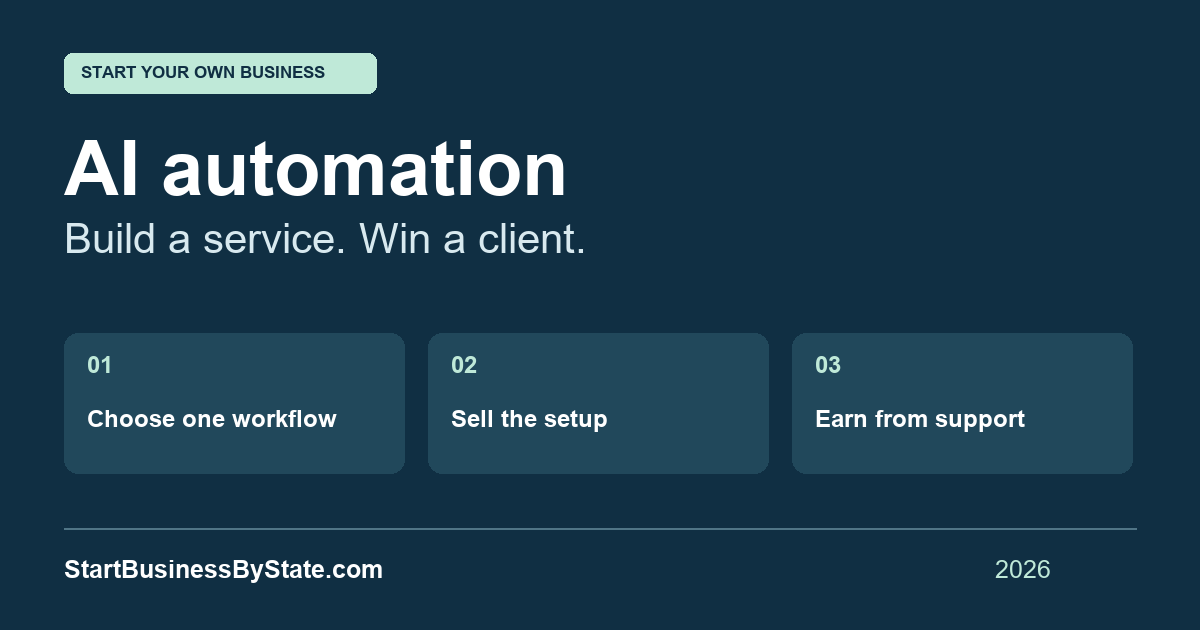 ## 7. Get your first AI automation client A useful opening might be: “I build inquiry-intake systems for home-service businesses.
Weekly search suggestions and recent industry reports highlight a growing demand for 'AI automation services' specifically for small and home service businesses. The provided source material identifies a crucial gap between simple, rule-based triggers and robust, agentic AI workflows, prompting an analysis of how to build and maintain these systems.