

For many small businesses, the promise of AI often feels restricted to either superficial chatbots or overly complex, expensive enterprise software. However, the true value of AI lies in workflow automation—the precise act of delegating repetitive, judgment-heavy tasks to language models while keeping the underlying process logic firmly under your control [1].
Unlike autonomous 'agents' that attempt to make independent decisions, AI workflow automation uses a fixed sequence of steps defined by developers or operators. This approach offers a significant advantage in reliability, providing a predictable framework where AI handles the nuance of reading, writing, or classifying data, while business rules manage the flow [1, 4].
Understanding the AI Automation Spectrum
To implement AI effectively, it is essential to distinguish between three common levels of business logic. Rule-based automation is the foundation of digital operations, utilizing fixed 'if-then' logic to handle structured data. This remains the most cost-effective and reliable method for tasks where inputs are predictable [1].
AI workflow automation introduces a Large Language Model (LLM) into this sequence. It acts as an intelligent node that can interpret unstructured data—such as reading a complex email or extracting fields from a PDF—before passing the processed information back into the structured pipeline [1, 4].
AI agents represent the most advanced tier, where the model decides which tools to use and what sequence to follow. While powerful, they are currently prone to high costs, 'runaway' spending, and unpredictability, making them risky for most small business core processes [1].
The Strategic Architecture: Build vs. Run
A common failure mode in AI integration is the neglect of the 'run' phase. Many businesses treat automation as a one-time project, failing to account for API changes, model updates, or shifts in business logic. Professional automation agencies now operate on a 'build-run' split [7].
The 'build' phase is a capital expense involving mapping, development, and testing. The 'run' phase is a recurring operational expense dedicated to monitoring, maintenance, and periodic updates. Treating the latter as a necessary subscription—much like payroll or cloud hosting—is essential for long-term stability [7].
Mapping Your Existing Workflow
Before writing a single line of code or setting up a Zapier trigger, you must document the current process manually. This involves identifying the specific systems involved, such as your CRM, email client, or accounting software [1, 6].
Assign every step in your workflow to one of three categories: Rule-Based (fixed data moves), AI-Enhanced (requires reading or summarizing), or Human-Only (judgment calls). If a step cannot be clearly defined or measured, it should remain manual until the process is better understood [1, 4].
- Document current volumes and exceptions.
- Identify the 'cost of error' for every step.
- Map the data flow across existing tools.
- Define the manual review trigger.
Implementation: From Theory to Production
The most successful implementations begin with a 'narrow path.' Select one specific input—such as a customer inquiry—and automate the path from intake to record creation. Do not attempt to automate every edge case in the first version [1, 6].
During development, create a robust testing set. Collect real-world examples of past documents, emails, or calls and ensure your automation produces the intended output every time. This creates a baseline against which you can measure the performance of new models or changes to your workflow [1, 3].
Failure Modes and Safety Nets
AI models are not deterministic; they can hallucinate or fail to format data as expected. Therefore, every production-grade automation must have a human-in-the-loop (HITL) checkpoint. This is not a failure of the technology; it is a feature of professional system design [4].
If an AI model is uncertain about a classification, the system should automatically route that specific task to a 'review queue' rather than pushing it downstream. This prevents bad data from corrupting your CRM or invoicing systems [1, 4].
Evaluating ROI and Costs
Automation ROI is calculated by comparing the time saved against the cost of build and maintenance. For many firms, the value isn't just in saved hours; it is in the reduction of response time for leads [6].
Consider the formula: (Hours Saved × Hourly Cost + Software Savings - Automation Maintenance) / Total Investment. If you are replacing a manual task that consumes 20 hours a week at £35/hr, you are creating over £30,000 of value annually [6, 7].
Security, Privacy, and Data Governance
Small businesses often overlook the compliance aspect of AI. When using APIs (such as OpenAI or Anthropic), ensure your provider agreement prohibits the use of your input data for model training. Furthermore, always implement the principle of least privilege: your automation service accounts should only have the permissions necessary to read and write the specific fields required for the task [1, 4].
Regularly audit the access tokens and API keys used in your integrations. If you are using platforms like Zapier or n8n, rotate your credentials annually and monitor logs for unusual volume or error spikes.
Action Checklist for Business Owners
To begin, start by auditing your tech stack for overlapping subscriptions that could be replaced by unified automation [6]. Second, identify the most tedious, repetitive task that requires reading text—this is your lowest-hanging fruit for ROI.
Finally, engage in a 'pilot' project. Do not overhaul the entire company at once. Build one end-to-end process, test it for 30 days alongside the manual process, and only switch over once the automation's error rate is demonstrably lower than human-only performance [1, 3].
The Evolution of the AI Automation Agency Landscape
In the rapidly maturing landscape of 2026, the role of the AI Automation Agency (AAA) has shifted from experimental tinkering to a core pillar of operational strategy for small businesses [2]. These agencies do not merely deploy off-the-shelf bots; they function as specialized architectural firms that translate chaotic, manual business processes into structured, programmatic workflows [1]. For a small business owner, engaging an agency represents a shift from capital expenditure on software to an investment in efficiency as a service, often bypassing the need to hire internal machine learning engineers who are costly and difficult to retain.
The current service model emphasizes 'Live in 3–6 Weeks' delivery cycles, focusing on rapid deployment of localized AI agents that handle specialized tasks like invoice reconciliation, lead enrichment, or customer support ticket routing [4]. By prioritizing speed-to-value, these agencies minimize the traditional friction of long-term digital transformations. They leverage proprietary integration frameworks that connect legacy software—often dated CRM systems or accounting spreadsheets—to modern Large Language Models, bridging the gap between historical data and future-proof intelligence [3].
Furthermore, modern AI automation is moving toward the concept of 'Orchestration.' It is no longer enough to have a bot that summarizes emails; businesses require a cohesive system where an AI, a database, and an API work in concert [3]. Agencies act as the connective tissue for these disparate technologies, ensuring that the automation does not create 'data silos' but rather enhances the visibility of business performance across departments [2]. This orchestration layer is essential for scaling, as it allows for the modular addition of new automation modules without requiring a complete overhaul of the existing system architecture.
A critical advantage of utilizing professional automation services is the focus on human-in-the-loop (HITL) design. Agencies recognize that fully autonomous systems often fail in nuanced client interactions [4]. Therefore, they design workflows that allow business staff to review, edit, or approve AI-generated outputs before they reach customers or external partners. This approach effectively mitigates the risks associated with 'hallucinations' or erratic AI behavior, providing a psychological and operational safety net for small business leaders transitioning to automated workflows [5].
- Transitioning from software-based cost centers to efficiency-as-a-service models for predictable ROI.
- Deploying modular automation agents that focus on high-volume, repetitive administrative bottlenecks [1].
- Prioritizing human-in-the-loop oversight to ensure brand consistency and error correction [4].
- Integrating legacy database infrastructure with modern API-driven LLM systems for unified operational views [3].
The Economics of Implementation: Pricing and Value Models
As the market for AI automation matures, pricing models have become increasingly transparent, though they remain highly dependent on the complexity of the data integration required [5]. Many agencies now offer tiered engagement models, ranging from 'Done-For-You' implementation services to ongoing maintenance and optimization retainers. Understanding these models is essential for small business owners who must budget not just for the initial setup, but for the evolving compute costs and API usage fees that characterize modern AI workflows [5].
The cost-to-value ratio is often determined by the 'automation potential' of a business process. Tasks that are high-volume, rule-based, and digital-first carry the lowest implementation costs and the fastest path to positive ROI [2]. Conversely, complex workflows that require deep document understanding or high-stakes decision-making necessitate custom prompt engineering and rigorous testing phases, which naturally increase initial capital requirements. Agencies provide value by conducting an audit to identify these 'low-hanging fruit' tasks, ensuring that the most impactful automations are addressed first to fund subsequent projects [1].
Beyond upfront costs, owners must account for the hidden 'operational tax' of running AI. This includes the token costs of the LLMs used, the storage requirements for large datasets, and the recurring subscription costs of orchestration tools like Zapier, Make, or custom middleware [5]. A sophisticated agency will help owners calculate the total cost of ownership (TCO) by forecasting usage patterns, helping them move from proof-of-concept to a sustainable, scalable operational expense model [3].
The value proposition for small businesses often centers on capacity expansion without headcount growth. By automating the middle-office functions—such as supply chain tracking or CRM maintenance—businesses can double their operational throughput using existing personnel [4]. This scaling efficiency is the primary driver of the current adoption rate, as it allows small businesses to compete with enterprise-level organizations by maintaining a lean, agile structure enabled by automated digital intelligence.
- Distinguishing between initial implementation fees and recurring operational expenses like API tokens [5].
- Evaluating the automation potential of tasks based on frequency and complexity [2].
- Calculating Total Cost of Ownership (TCO) to avoid budget surprises during scaling [5].
- Focusing on middle-office automations to increase operational throughput without expanding payroll [4].
Technical Foundations for Custom Automation Systems
Building a custom AI automation system requires more than just connecting two applications; it demands a robust backend architecture that ensures data consistency and reliability [3]. Most custom systems rely on a 'message-broker' or 'webhook' architecture, where events—such as the arrival of a new email or a form submission—trigger specific workflows within an automation platform [5]. This event-driven approach ensures that the system remains dormant and cost-effective until an actual task requires processing.
The challenge often lies in data transformation. Raw data from a client’s internal legacy software is rarely ready for an AI agent to consume. Therefore, the implementation phase involves extensive data cleaning and mapping exercises [1]. Agencies use middleware to reformat data into JSON or other structured formats, ensuring that the AI receives clear, unambiguous instructions. Without this layer of technical rigor, even the most advanced AI model will struggle to perform reliably, leading to the dreaded 'garbage in, garbage out' scenario [3].
Another critical technical component is the 'state management' of an automation. A system must know if a task is currently in progress, waiting for approval, or completed. High-quality automation architectures implement persistent databases to track these states [3]. This prevents the system from running duplicate tasks or missing data transitions if a server restarts or an API connection drops. Reliability in these systems is non-negotiable, as small businesses cannot afford to lose track of sensitive financial or client data during the migration to automated processes.
Finally, security-first engineering is paramount. Custom systems should utilize encrypted webhooks, secure API key management, and least-privilege access protocols [5]. By isolating the AI’s reach to only the necessary data segments, agencies protect the business from potential data leaks or unauthorized command execution. This layer of defensive programming is the final piece of the architectural puzzle that distinguishes a hobbyist’s script from a professional-grade business system.
- Implementing event-driven architectures to ensure systems trigger only when required [5].
- Utilizing middleware for robust data cleaning and mapping to maintain accuracy [1].
- Employing persistent databases for state management to prevent task duplication or loss [3].
- Enforcing strict least-privilege access and API security to minimize data risk [5].
Navigating the Future of Agentic Workflows
As we look beyond simple automation, the field is moving toward 'Agentic Workflows'—systems where AI agents are given a goal and the autonomy to plan and execute a series of steps to achieve it [2]. Unlike traditional scripts, which follow rigid 'if-this-then-that' logic, agents can evaluate their own progress, ask for clarification, and adjust their strategy if they hit a roadblock [5]. This shift represents the final frontier for small business efficiency, moving from manual task execution to autonomous process ownership.
For the business owner, this means the nature of management will change. Instead of defining exactly how a task must be completed, the owner defines the objective, the constraints, and the success metrics. The AI then iterates on the method, often finding efficiencies that a human might overlook [1]. However, this autonomy requires a new set of 'governance rules'—explicit parameters that define the limits of what the agent can and cannot do. Agencies are currently developing these governance frameworks to ensure that autonomous agents stay within budget, safety, and brand-identity constraints [4].
Maintaining these systems requires a proactive mindset. AI models evolve, and APIs are frequently updated, which can break existing workflows [5]. A professional AI automation agency acts as a long-term partner, performing routine 'health checks' to ensure that automations are still performing optimally under new model releases [3]. They monitor performance metrics, such as error rates and task completion times, to adjust the agent’s logic as the business environment changes.
Ultimately, the goal of scaling AI automation is not to remove humans from the loop entirely, but to elevate their roles. By offloading the high-volume, cognitive-load-heavy tasks to AI, employees can focus on high-value activities that require empathy, complex negotiation, and creative strategy [1]. This symbiotic relationship between human intelligence and machine efficiency defines the future of the resilient, modern small business.
- Transitioning from rigid scripts to autonomous, goal-oriented agentic workflows [2].
- Establishing clear governance and constraints to manage agent autonomy [4].
- Implementing routine health checks to ensure workflows remain functional as APIs update [3].
- Reclaiming human capacity for high-value strategic and empathetic work [1].
Frequently asked questions
What is the difference between an AI agent and AI workflow automation?
AI workflow automation follows a fixed sequence of steps determined by a developer, using AI for specific tasks like reading or drafting. An AI agent, by contrast, chooses its own steps and tools at runtime, which is significantly more complex and harder to manage.
How do I calculate the ROI of an automation project?
Calculate ROI by multiplying the time saved per week by the hourly labor cost, adding any software savings, and subtracting the ongoing monthly maintenance and API usage costs.
Do I need a custom-coded solution or can I use no-code tools?
Both are valid. Many small businesses start with no-code platforms like Zapier or n8n. As complexity grows, transitioning to custom scripts allows for better testing, version control, and lower API overhead.
What happens when the AI makes a mistake?
A well-designed system includes 'confidence thresholds.' If the AI is below a certain certainty level, the process is routed to a human review queue, ensuring the error is caught before it enters your downstream systems.
What is the primary difference between a simple automation script and an AI automation agent?
A simple automation script operates on rigid, 'if-then' logic, executing a pre-defined sequence of steps regardless of variations in the input data. An AI automation agent, however, uses Large Language Models (LLMs) to interpret context, handle unstructured data, and make decisions based on the objective it is given [1]. While a script is brittle and requires manual updates for every variation, an agent can often adapt its own logic to resolve ambiguities, making it far more versatile for dynamic business environments [3].
How do AI automation agencies ensure the security of my business data?
Reputable agencies employ a layered security approach that includes encrypting all data in transit, implementing 'least-privilege' access so the AI only interacts with necessary databases, and utilizing secure API key management systems [5]. They also design workflows with a 'human-in-the-loop' constraint, ensuring that sensitive data is reviewed by an authorized human before it leaves the company’s internal environment. Furthermore, agencies strictly avoid training public AI models on private, proprietary business data, ensuring that your corporate intelligence remains confidential [4].
What is the expected timeline for a small business to see a return on investment (ROI) from AI automation?
Many businesses start seeing operational efficiencies within 3–6 weeks of implementation, particularly when focusing on high-volume, low-complexity tasks like data entry or email sorting [4]. However, financial ROI depends on the complexity of the workflow and the baseline cost of the human labor it replaces. Most professional agencies conduct a pre-project audit to estimate the potential time savings and cost reduction, helping business owners select high-impact projects that yield positive returns early in the implementation cycle [1][5].
Sources & further reading
- 1. AI Automation Agency in USA | Live in 3–6 Weeks - CloudMotivcloudmotiv.ai
We automate sales, CRM, support and back-office work with AI. Setup from $1500, first workflow live in 3–6 weeks. Call (510) 730-0080 for a free 30-minute ...
- 2. AI Automation Services & AI Workflow Automationeasital.com
## Ways to work with us AI automation consulting on one area of your business.
- 3. AI Automation Services for Your Businessgetfriday.com
# AI Automation Services for Your Business ## Automation that works alongside your assistant, not instead of one AI tools are quick at repetitive, high-volume work: sorting leads, answering common questions, updating records, drafting first versions of reports. The trouble is that most small businesses have nobody to set them up, connect them to existing systems and make sure they keep working. That's what we do. We set up AI automation in the systems you already use, and a dedicated assistant
- 4. How to Start an AI Automation Business (2026)startbusinessbystate.com
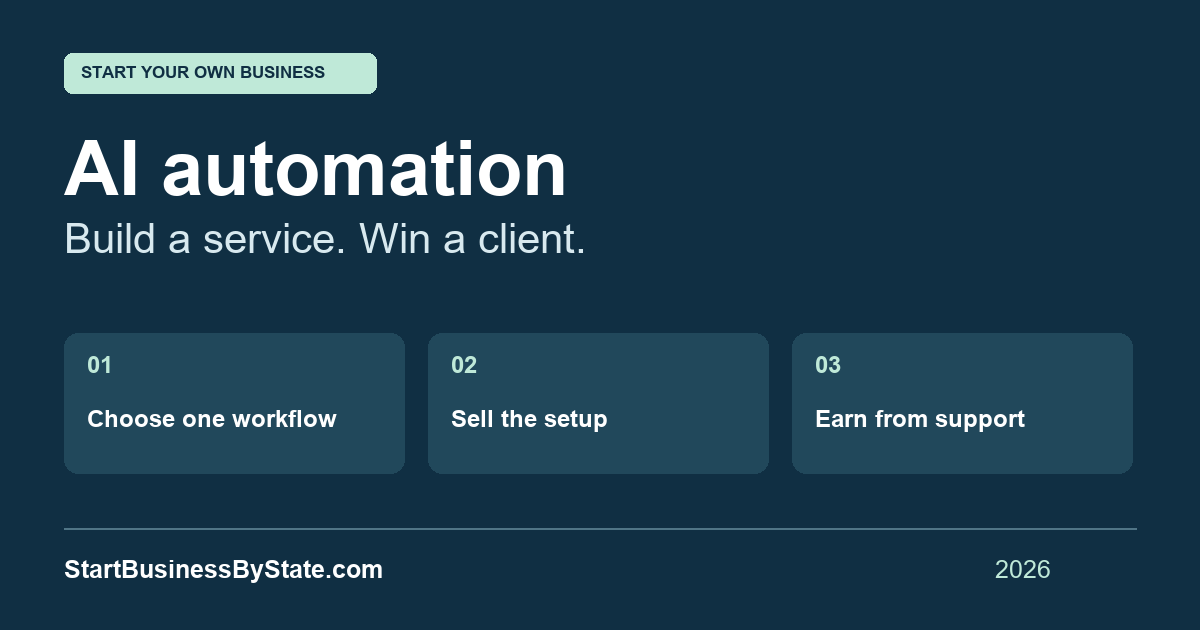 ## 7. Get your first AI automation client A useful opening might be: “I build inquiry-intake systems for home-service businesses.
- 5. AI Automation Services (2026): Prices, Models and Datavirtustant.com
# AI Automation Services (2026): Published Prices, the Build-Run Split and What 26 Automation Hires Show ## What AI Automation Services Cover | Work | What it looks like | Typical tools | |-|-|-| | Business process automation | Multi-step processes across systems, with approvals, error handling and reporting | APIs, webhooks, SQL, Python or JavaScript scripts |
The research identified a critical gap between simple no-code tools and enterprise-level AI agents for small businesses. Insights from recent industry reports [1, 3, 6] confirm that businesses often struggle with maintaining automations once they are built, necessitating a deeper look at the 'build-run' split.